

about us
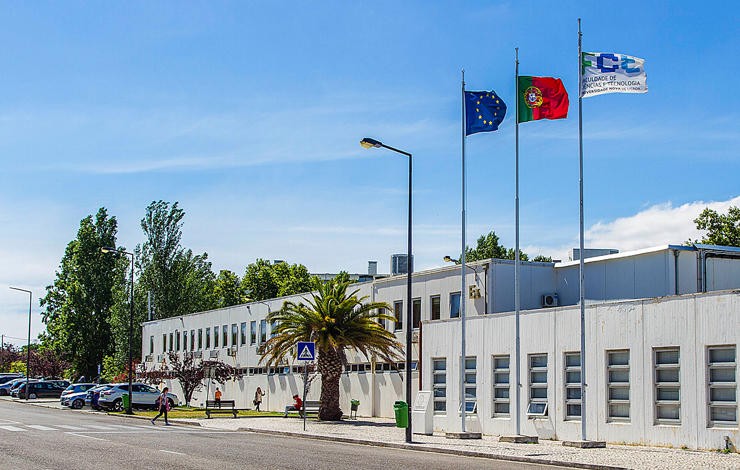
NOVA SCHOOL OF SCIENCE AND TECHNOLOGY
NOVA FCT, with about 8500 students, has one of the best university campuses and isdistinguished by a culture of excellent teacher-student relationships and an intense academic life with many different cultural and sport activities.
All courses are accredited by the A3ES (Agency for Assessment and Accreditation of Higher Education) and all Engineering courses are recognized by the Order of Engineers, FEANI (Federation of Professional Engineers that unites national engineering associations from 33 European Higher Education Area (EHEA) countries) and EUR-ACE (European Accredited Engineer).
NOVA FCT is structured in 13 Departments and 16 Research Centers, offering 117 study cycles. NOVA.ID.FCT (Associação para a Inovação e Desenvolvimento da FCT) is a private non-profit research organisation devoted to R&D&I activities, recognised by the Portuguese System for Science and Technology of FCT (Fundação para a Ciência e Tecnologia). NOVA.ID.FCT based at FCT NOVA acts as the legal institution of research units, carrying out research work and managing R&D&I projects. Its scientific production, resulting from the publication of a large number of articles in international scientific journals of great demand and quality, gives it wide international recognition. This performance allows the faculty to integrate the main technological university networks, such as the CESAER network and to participate in consortiums with European and US universities, namely MIT, CMU and the University of Texas.
The participation in 9 COLABs and the 17 ERC scholarships obtained by NOVA FCT researchers (the largest concentration of these laboratories and scholarships in Portuguese Universities), demonstrates how the NOVA School of Science and Technology is oriented towards the future and based on vanguard international research.
Materials Science Department
The Department of Materials Science (DCM) of NOVA FCT was the first of its kind to be established at the national level, in 1976. Its initial objective was to create university extension courses in the field of materials, ultimately leading to the establishment of a dedicated undergraduate degree covering a broad range of scientific domains, namely metallurgy, semiconductor materials, polymeric and mesomorphic materials, ceramic materials and glasses, crystal chemistry, and quality control. Since then, DCM has grown significantly and diversified its activities, largely due to the sustained efforts of its academic and technical staff. This development is reflected in a large number of academic and industrial projects funded by national, European, and international agencies. Such growth has enabled the Department to continuously adapt to emerging technologies and to develop laboratory infrastructures unique in Portugal, for both education and research, which are internationally recognized. These conditions have supported the training of highly qualified Materials and Micro and Nanotechnology Engineers, with strong scientific and technical skills, capable of responding effectively to the demands of contemporary society.
Materials for Electronics, Optoelectronics and Nanotechnologies Group
The Materials for Electronics, Optoelectronics and Nanotechnologies (MEON) group is a major research group within the Centre for Materials Research (CENIMAT), affiliated with the Department of Materials Science (DCM) at NOVA School of Science and Technology (NOVA FCT). The aim of the MEON group is to design, develop, and integrate advanced functional materials and devices for next-generation electronic, optoelectronic, and nano-enabled technologies. The group focuses on bridging fundamental materials science and applied device engineering, with a strong emphasis on low-temperature, flexible, transparent, and sustainable electronics.
MEON seeks to create innovative material solutions and electronic systems that enable new functionalities, reduced environmental impact, and compatibility with unconventional substrates (such as paper, polymers, and textiles). Through this approach, the group aims to contribute to emerging fields including flexible and wearable electronics, energy harvesting and storage, neuromorphic and bioelectronics, while fostering technology transfer, industrial collaboration, and advanced training of highly qualified researchers.
PEOPLE

Emanuel Carlos
Is an Assistant Researcher and Research Area Leader (RA#1 – Flexible and Sustainable Electronics) of MEON at CENIMAT|i3N Department of Materials Science, NOVA School of Science and Technology from NOVA University Lisbon. He is Local PI of TRANSPER and ELEGANCE EU projects and co-PI of national (SECURE, PRR R2U, BE.NEUTRAL) and international (GAIA and INFRACHIP) projects. He completed his PhD in Nanotechnologies and Nanosciences at NOVA University Lisbon in 2021, including research stays at Nottingham Trent University (UK) and VTT (Finland) under the EIT Raw Materials IDS-FunMat-Inno program.
Since 2015, he has worked on solution-based metal oxide electronics, focusing on sustainable materials and printing technologies (inkjet, flexographic, screen printing) for flexible devices. His research spans material design, deposition, characterization, and device fabrication, and he has co-authored 30+ peer-reviewed papers and 4 book chapters.
Emanuel has received multiple awards recognizing scientific excellence and innovation, including the Early Career Researcher Medal (IAAM, 2025), appointment as Early Career Board Member of ACS Applied Electronic Materials, the International Sol-Gel Society PhD Thesis Award – Gold Medal (2022), and the Frontier Materials Graduate Student Award (IUMRS, 2022), reflecting his international leadership in sustainable and printed electronics.
Henrique Almeida
Is an Assistant Researcher (tenure track) and Research Area Leader (RA#3 – Bioelectronic and Biomedical Devices) of MEON at CENIMAT|i3N, Department of Materials Science, NOVA School of Science and Technology from NOVA University Lisbon. Dr. Vazão de Almeida got a PhD in Bioengineering from Trinity College Dublin in 2016 and a master’s in Materials Science and Engineering from NOVA School of Science and Technology. He was in the Biomedical Industry for five years before starting his doctoral studies. His research spans bioelectronics, bioengineering, materials science, biomaterials, tissue engineering, nature-derived materials, additive manufacturing, and laser-based processes. He focuses on conductive biomaterials, bioelectronic devices for biomedical applications, regenerative medicine, and antibacterial materials for smart packaging/surfaces. Dr. Vazão de Almeida has led and contributed to various national and European projects, including EMERGE, E-GREEN, LIGHEART, Blue Bioeconomy Pact, From Fossil to Forest, 3DbioprintCTE, PEFPlateletValue, NETDIAMOND, and CARDIOSTEM. His honors include an FCT postdoctoral and a CEEC fellowship, an IOP Publishing Outstanding Reviewer Award, two CRANN Commercialization Awards, the GREP in Engineering funding award (Trinity College Dublin), and recognition as the top master’s graduate in his cohort. He also teaches at NOVA University and has been mentoring master’s and Ph.D. students. He is the author of over thirty-five scientific publications, holds a patent, and is advancing innovative bioelectronic platforms and biomaterials for tissue engineering and personalized medicine.


Is an Associate Professor in the Materials Science Department at NOVA School of Science and Technology, NOVA University Lisbon, where she leads a research team dedicated to advanced functional materials for sustainability-driven applications, including energy, CO₂ capture and utilization, and biomaterials. Her research focuses on ionic-liquid-derived materials, such as poly(ionic liquid)s, ion gels, aerogels, and other soft and porous systems, exploring controlled transitions between structured, soft, and porous states to establish robust structure–property–function relationships and enable the rational design of materials with tunable performance. A central pillar of her work is the application of advanced NMR-based techniques, including high-pressure NMR, solid-state NMR, and magnetic resonance imaging, to probe local environments, molecular dynamics, transport phenomena, and interaction mechanisms under relevant operating conditions, directly supporting materials engineering and process-oriented optimization. She has coordinated national research projects, including GREENNPILs4CO2 (2018–2022) and the ongoing AERO2cycle project, has served as NOVA FCT team coordinator in the CLEANArt project (2016–2019), and is NOVA FCT team leader in the ongoing INTERREG Atlantic Area project RESILCROPs. Her research integrates advanced characterization, materials design, and sustainability targets, reinforcing her role in driving innovative and impactful materials research.

Is an Assistant Professor at the Materials Science Department, NOVA FCT, Portugal. She received her Ph.D in Applied Physics in 2008 from NOVA School of Science and Technology (NOVA FCT) and started a PosDoc at CENIMAT in the same year dedicated to the development of thin film transistors based on amorphous oxides, to be used as biosensors. Since 2015 she is an Assistant Professor at the Materials Science Department of NOVA FCT NOVA lecturing on Micro and Nanotechnologies Engineering Master Program. Her main activities have been focused on fabrication and characterization of microelectronic devices and their integration into flexible and conformal substrates. Fabricated devices include Ion sensitive filed effect transistors as biosensors to detect pH and bioagents, TFTs Supercapacitors and photo sensors. She has been exploiting Parylene-C in its wide range of applications as substrate, dielectric, and encapsulation layers for different devices, like TFTs, capacitive/resistive sensors, RFID antennas solar cells and electrochromic displays. She participated in several National and European funded projects and more recently she was the local principal investigator at NOVA of an European Project, SUPERIOT, that ended in 2025 and that was dedicated to the development of fully printed technology nodes with radio and optical communication possibilities in flexible sensing demonstrators. Currently she is the local PI of a starting project with Macau University focused on the development of FET biosensors on conformable parylene substrates to detect plant biomarker – GREENSense
Is a PhD student in the final year at CENIMAT|i3N, NOVA School of Science and Technology, working on the design and characterization of next-generation flexible sensors based on nature-derived and piezoelectric materials for pressure sensing applications. She holds a Master’s degree in Biomedical Engineering from the same university, where she developed zinc oxide nanostructures for non-invasive and non-enzymatic glucose sensing. Maria’s research expertise includes the synthesis of metal and metal-oxide nanostructures and the use of advanced materials characterization techniques, with a special focus on X-ray diffraction. Her work bridges materials science and flexible sensor technologies, with a strong interest in functional nanostructured systems for healthcare and smart devices.